
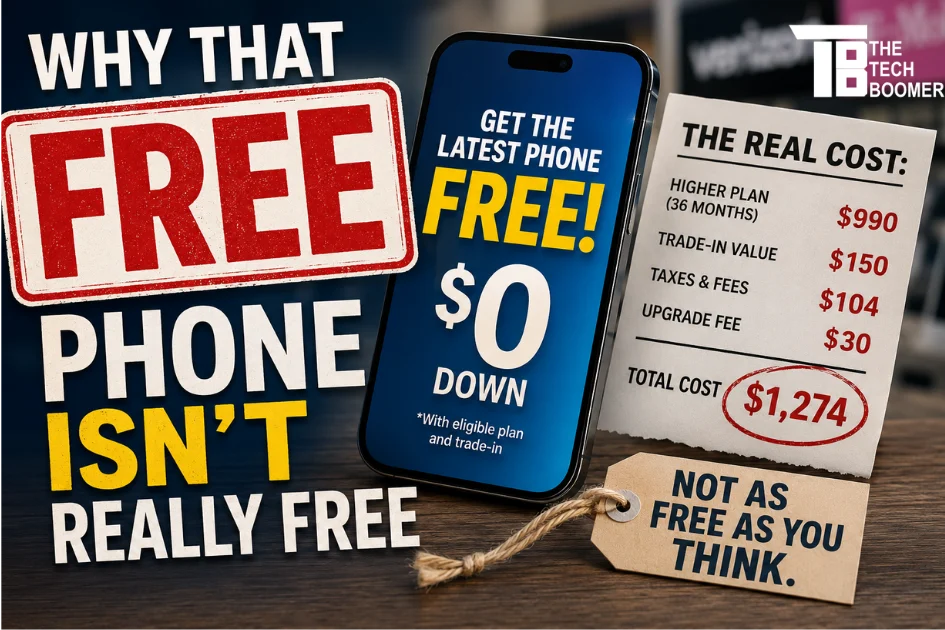
Every time you turn around, somebody is offering you a free phone. “Get the newest flagship device for $0.” Walk into a store, walk out with a new phone, and somehow pay nothing for it.
Wow, what a deal!
Major carriers like AT&T, Verizon, and T-Mobile are constantly advertising free phone promotions, especially when a new iPhone, Galaxy, or Pixel launches. They make it feel simple: trade in your old device, and bam! A brand-new phone in your pocket for free.

TOZO T10 Wireless Bluetooth Earbuds
The Tech Boomer recommends these wireless bluetooth earbuds. Clear, crisp sound—plus they’re easy on the wallet!
View on Amazon →This post may contain affiliate links. As an Amazon Associate, I earn from qualifying purchases.
But here’s the reality: that “free phone” almost always comes with strings attached. And those strings usually last 36 months and can cost you big bucks.
In this article, I’m going to break down how much a free phone really costs, how carriers work these deals, and why understanding the fine print can save you hundreds of dollars or more over the life of your plan. Because when it comes to wireless carriers, “free” rarely means what you think it means.
How Carriers Advertise a “Free Phone”
When carriers promote a free phone, they’re very careful with their wording. You’ll see phrases like “$0 down,” “on us,” or “free with eligible plan.” Technically, they’re not lying – but they’re definitely not telling the whole story in big bold letters, either. Those details are relegated to the fine print behind the asterisk.
Here’s how it usually works:
Instead of handing you a phone that costs nothing, carriers like AT&T, Verizon, and T-Mobile sell you the device at full retail price (of course they didn’t pay retail for it). Then, they apply monthly bill credits over 36 months to offset that cost.
For example, if a phone costs $1,000, you might see it advertised as “FREE.” What actually happens is:
- You finance the $1,000 phone over 36 months.
- The carrier adds a device payment to your bill each month.
- Then they apply a matching monthly credit.
As long as you stay on a qualifying plan for the entire term, those credits continue until the balance is effectively zero.
It feels free — because the payment and the credit cancel each other out.
But here’s the catch: the credits only continue if you keep the service active and meet all the promotion requirements. If you cancel early, change plans, the remaining credits will disappear and you’re suddenly responsible for the unpaid balance.
So let’s say that you decide that their service isn’t what it’s cracked up to be, or you are having some financial difficulties and need a less expensive plan. If you cancel, now you owe the balance on that free phone, and no, they don’t want it back.
So when carriers advertise a free phone, what they’re really offering is a conditional discount spread out over time – not a no-strings-attached giveaway.
And that difference matters.
What You’re Really Paying For
So if the phone isn’t truly free, where does the money come from?
The answer: the service plan.
To qualify for a free phone, carriers typically require you to sign up for one of their higher-tier unlimited plans. With companies like AT&T, Verizon, and T-Mobile, that often means plans costing $75 per month or more for a single line before taxes and fees.
Over 36 months, that’s $2,700 or more in service costs alone.
Now compare that to buying a $800–$1,000 phone outright and pairing it with a prepaid or lower-cost plan that might run $50 per month. Over the same three years, that cheaper plan could save you close to $1,000.
And that’s just the beginning.
Here are some of the other things you’re often paying for:
Trade-in requirements. Many promotions require you to hand over a perfectly good phone to qualify.
Sales tax upfront. Even if the device is “free,” you usually pay sales tax on the full retail price at checkout.
Activation or upgrade fees. These can run $30 – $35 per line. Even if you already have service with that carrier.
Long commitment periods. Typically 36 months.
Early cancellation penalties. Leaving a contract early means you lose remaining credits and must pay off the balance immediately.
In other words, the phone may show up as $0 on paper, but you’re committing to a long, expensive service relationship to make that math work.
The real product isn’t the phone.
It’s the plan.
AT&T’s “Free Phone” Deals — A Closer Look
Let’s use AT&T as a real-world example of how the free phone pitch works.
AT&T regularly advertises high-end devices like theSamsung Galaxy S26 Ultra, iPhone 17 Pro Max, or the Google Pixel 10 Pro as “FREE” with an eligible trade-in and unlimited plan. On the surface, that sounds incredible – flagship phone, zero dollars.
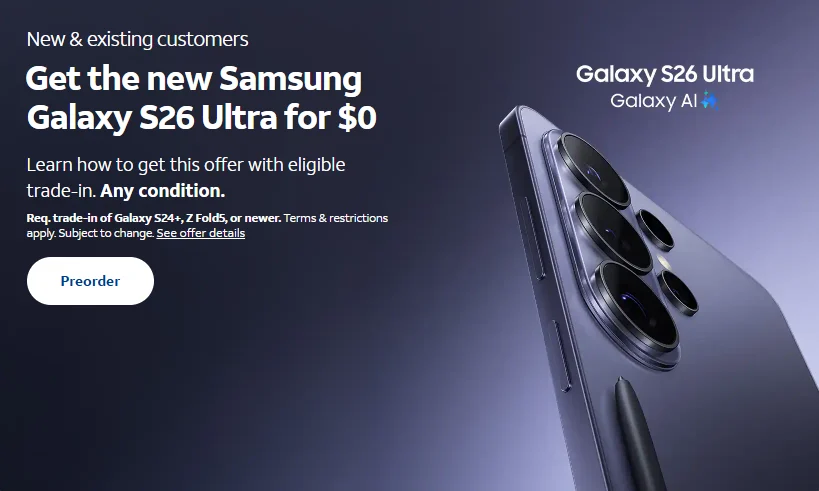
Here’s what actually happens behind the scenes:
- You finance the full retail price of the phone (in this case $1300.00).
- You must trade in a qualifying device that meets specific value requirements.
- You’re required to activate or maintain a premium unlimited plan.
- AT&T applies monthly bill credits over 36 months to offset the device payments.
If you keep the line active and stay on the qualifying plan for the full 36 months, the credits will eventually equal the full price of the device. That’s how it becomes “free.”
But if you:
- Cancel service early
- Switch to a lower-cost plan that doesn’t qualify
- Miss a trade-in deadline or fail to meet the device condition requirements
The remaining credits stop — and you owe the unpaid balance immediately.
Now here’s the bigger picture. A premium unlimited plan can easily cost $75.00 or more per month before taxes and fees. Over three years, that’s $2,700 in plan charges – not counting add-ons, insurance, or activation fees.
So while the phone may technically cost $0 after credits, the long-term service commitment is where AT&T makes its money.
Here are some parts of the details of this promotion from AT&T’s website:
- Customers must pay tax on full retail price and an activation/upgrade fee of $35 per line.
AT&T states the retail price as $1300. Tax in my county is 8%, this means $104.00 in tax, plus the $35 fee. - The offer is valid with the trade-in of Galaxy S24+, Z Fold5 or newer in any condition, or an eligible smartphone that has a minimum trade-in value of $230 for up to $1,300 off Galaxy S26 Ultra; Galaxy S22+, Z Fold3 or higher in any condition, or an eligible smartphone that has a minimum trade-in value of $95 for up to $1,100 off Galaxy S26+; Galaxy S, Note or Z series smartphone in any condition or min. trade-in value of $35 for up to $900 off Galaxy S26.
So you only get the “free phone” if you already have a newer phone. Trading in an older phone gives you a “discounted” phone. - The trade-in device must not be on an existing installment plan.
So if you got your current “free phone” less than 3 years ago, tough. You’ll have to wait until that contract expires. - The offer requires a postpaid unlimited voice and data plan starting at $75.99/month.
AT&T offers a “Value plus” unlimited plan for $50.99. - If wireless service is canceled, promo credits will stop, and the remaining balance on the device must be paid.
You’re stuck with this carrier even if their service is crappy.
Let’s see:
- $25 extra for a plan ($75.99 – $50.99) times 36 months = $900.00
- $104.00 Tax
- $35 Activation fee
Total $1,039 for a free phone.
And the other carriers offer a similar deal.
Verizon’s Free Phone Offer
I’m currently on Verizon and I carry a Google Pixel 7. I’m not really in the market for the newest phone yet (Pixel 10), but let’s see what Verizon has to offer for me to get a new “free phone”:
- I must upgrade my line to the “Unlimited Ultimate plan“ which is $72.50 compared to my current plan at $45.00. ($72.50 – $45.00 = $27.50 x 36 months = $990.00)
- $30 Upgrade fee. (If I want to give them more money I have to give them more money for the privilege of giving them more money)
- Trade in my Pixel 7 (selling on eBay for around $150.00)
- Upgraded plan $990
- Upgrade fee $30
- Giving them my current phone $150
Total $1,170.00 to get a free $599 phone
Or I could:
- Pay $599.00 to Amazon for a new Pixel 10
- Sell my Pixel 7 on eBay for $150.00
- Keep my $45.00 Verizon plan
Total $449.00
Note: I didn’t include sales tax, as it would be the same for both phones.
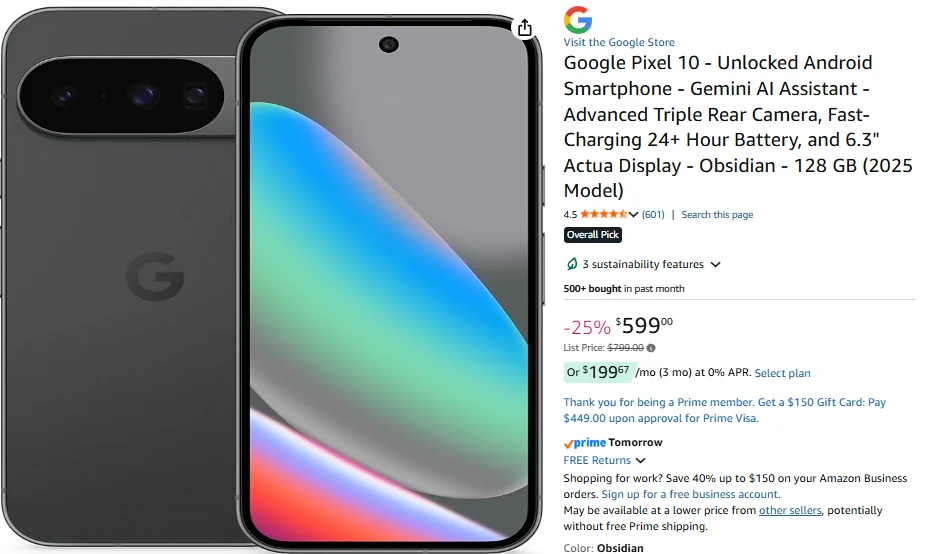
The free phone isn’t a giveaway.
It’s a hook.
Other Carriers And Their Free Phones
The “deals” from the other carriers are similar, please check the fine print before you commit.
Tips for Savvy Shoppers
So how do you avoid getting taken in by the shiny “free phone” banner and making a decision you might regret a few months from now?
Here’s how to shop smarter:
1. Calculate the Total Cost — Not the Monthly Cost
Carriers love to focus on “$0 for the phone” or “just $35/month.” Instead, multiply that plan cost by 36 months. Then compare it to:
Buying the phone outright (or lightly used).
Pairing it with a lower-cost plan. Most people don’t need the “Super Ultra Unlimited Premier” plan.
Sometimes the math is shockingly different.
2. How much more you are going to have to pay for service
Multiply that over the 36 month contract period.
Compare that to a lower cost plan.
3. Read the Fine Print on Bill Credits
With carriers like AT&T, Verizon, and T-Mobile, those monthly credits only continue if you:
Stay on a qualifying plan
Keep the line active
Don’t pay off the phone early (in some cases)
If you leave early, the remaining balance becomes your responsibility. That “free” phone suddenly has a price tag.
4. Know What Your Trade-In Is Really Worth
Sometimes you’re giving up a perfectly good device that could be:
- Sold privately for more money
- Kept as a backup phone
- Passed down to a family member
Make sure the trade-in value is actually competitive.
5. Don’t Forget Taxes and Fees
Even with a free phone promotion, you’ll likely pay:
Sales tax on the full retail price
Activation or upgrade fees
Optional insurance
That can add up quickly at checkout.
6. Ask Yourself: Do I Actually Need the Upgrade?
Carriers bank on upgrade excitement. But if your current phone works fine, holding onto it for another year could save you far more than any promotion ever will.
The Bottom Line: “Free” Comes With a Price
Here’s the simple truth: a free phone from your carrier usually isn’t free.
It’s financed. It’s credited back to you slowly. And it’s tied to a long (and often expensive) service commitment.
Carriers like AT&T, Verizon, and T-Mobile aren’t in the business of giving away $1,000 devices out of the kindness of their hearts. They’re in the business of locking in predictable monthly revenue. The phone is the incentive. The plan is the profit.
That doesn’t automatically make these deals bad. If you were already planning to stay with your carrier for three years on a high priced premium unlimited plan, a bill-credit promotion might work in your favor.
But if you’re switching carriers, upgrading early, or choosing a more expensive plan solely to qualify for a “free” device, you may end up paying far more than the phone is worth.
Before you say yes to the shiny new upgrade, take five minutes and do the math:
Total service cost over 36 months
Upfront taxes and fees
Trade-in value versus selling privately
What happens if you leave early
Once you see the full picture, the word “free” starts to look a little different.
And that’s the real goal – not avoiding every promotion, but understanding exactly what you’re signing up for before you commit.

OTC Hearing Aids for Seniors
OTC Hearing Aids for Seniors, Hearing Aid Amplifiers Devices Rechargeable with Noise Cancelling, Superior Sound Quality for Adults Women Men Hearing Loss, Auto On/Off
View on Amazon →This post may contain affiliate links. As an Amazon Associate, I earn from qualifying purchases.